







You do not need a perfect routine, a new desk setup, or a long training plan to start. You need a first session you can finish and do again tomorrow.
This guide is for people who just bought a walking pad, or pulled one out because it is cold outside. It is a first-session walk-through, not a buying guide, and it is not medical advice. If you have a health condition, a recent injury, or balance concerns, follow your clinician's guidance and your machine's manual first.
What the first session should accomplish
The goal is not distance, calories, or a personal record. It is to:
- Set the pad up so you can step off safely.
- Learn the start, speed, and stop controls before you are tired.
- Walk for a comfortable 20–30 minutes—or a shorter block you know you can repeat.
- Write down what you did so the next session is the same, not a guess.
If 20 minutes is too much today, 10–15 minutes done well is a better start than one exhausted effort you will not repeat. A longer indoor beginner plan can wait until this session feels ordinary.
Set up the space before you step on
Follow your walking pad's manual for floor type, weight limit, and clearance. A few rules show up often on motorized walking belts, including full-size treadmills:
- Use a level, stable surface. Many manuals want a hard floor; if yours allows carpet, confirm that the unit sits flat and does not rock.
- Leave clear space behind the belt. Full-size treadmill manuals are often stricter than compact pads. A NordicTrack home treadmill manual, for example, asks for at least 8 ft (2.4 m) behind the machine and 2 ft (0.6 m) on each side (NordicTrack T-Series 5 User's Manual, NT-NTL17624-INT). ASTM F2115 guidance for motorized treadmills, as summarized in industry safety writing, is at least 2 m (about 78 in) behind and 0.5 m (about 20 in) on each side (CPH Insurance summary of ASTM F2115-12). Use your manual first; if the numbers disagree, keep the larger clear zone. Walking pads still need room behind you if you step too far back.
- Keep children, pets, cords, and furniture out of that space. Never leave a moving belt unattended.
- Wear supportive walking or running shoes. The same NordicTrack manual tells users not to walk barefoot, in socks only, or in sandals. That is about grip and footing on a moving belt, and it applies just as well to a pad.
- Know how to stop before you start: the remote, the console, the safety key or clip if your model has one, and the power switch.
Power the pad on and let the belt run empty at its lowest speed for a short time. You are checking that it tracks reasonably straight and that nothing sounds like grinding or scraping. If it does, stop and follow the manual; do not start the first session on a damaged belt.
If the pad was stored, dust it off, inspect the belt and power cord, and use only the lubrication or cleaning method the manufacturer specifies. Do not switch it on if you see moisture on the electronics. If it spent the off-season in a cold garage, read using a treadmill in a cold garage before you treat "plug in and go" as the whole checklist.
Many walking pads have no handrails. Do not put the pad under a desk for this first session. Divided attention changes balance. Walk on the pad by itself until starting, walking, and stepping off feel ordinary.
A first session you can repeat
Keep the first walk simple. Use the pad's lowest speed increments; models differ, so the numbers below are starting points, not a prescription.
- Stand on the side rails or stable frame, not the moving belt, if your model has them. Start the belt at its minimum speed.
- Step on when the belt is already moving slowly. Find your balance before you change speed.
- Easy minutes (about 5). Walk at a very easy pace—often in the neighborhood of a slow stroll, such as about 1.5–2.5 km/h (about 1.0–1.5 mph) if that range is available. It should feel almost too easy. This is for balance, posture, and learning the remote, not for effort.
- Comfortable walk (about 10–20 minutes). Raise speed in small steps until you can talk in full sentences and your steps feel stable. For many people that is a moderate walk, often somewhere around 3–5 km/h (about 2–3 mph), but your comfortable pace may be slower or a little faster. If the pad offers incline, leave it at 0% for the first session unless the manual says otherwise.
- Easy finish (about 3–5 minutes). Slow down before you step off. Step off to the side, then stop the belt.
Total time: about 20–30 minutes, or a shorter version of the same shape if you need it.
Stand tall, look ahead, and let your arms swing if you are not holding a remote. If you feel sudden pain, dizziness, chest pain, or unusual shortness of breath, stop, step off, and seek appropriate help.
How to repeat it
Do the same session again on the next day you walk. Do not add speed, incline, or a new interval workout until this one feels familiar.
When it does, change one thing at a time: a few more minutes, or a slightly quicker comfortable pace, not both. Three to four easy walks in a week is plenty at the beginning. If you later want a structured indoor plan, use the 4-week beginner treadmill plan. Japanese interval walking is a later option, and only if your pad can change speed smoothly; many pads cannot match treadmill incline workouts.
Log the walk so the next one is easy to copy
You do not need Bluetooth to keep this session.
Write down the date, total time, the speeds you used, incline if any, and one word for how it felt. That is enough. If you prefer a phone log, Manual mode in an app works the same way: you set the pace on the pad, and the phone keeps the timer and the record.
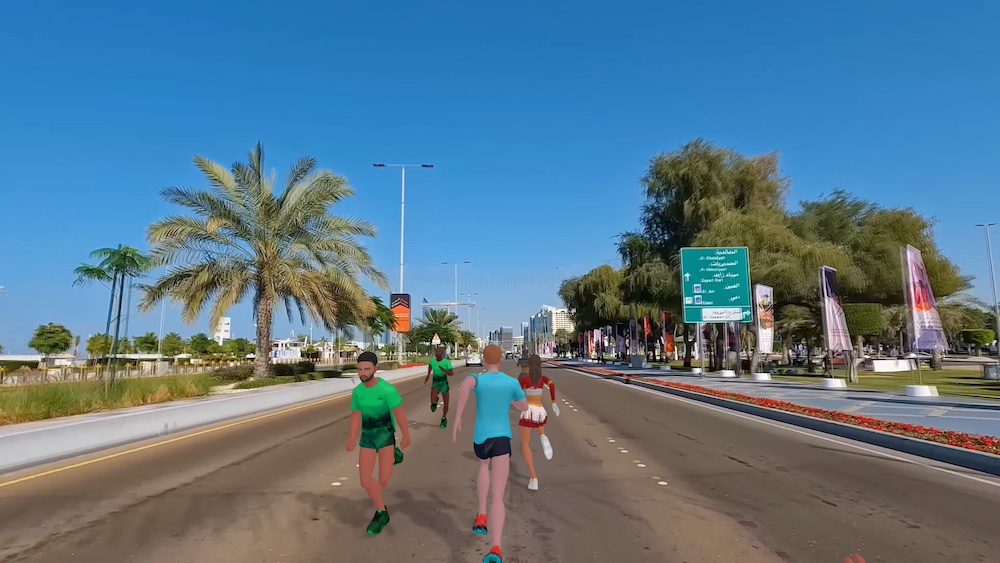
In Treadmill Buddy, Manual mode can also show an optional scenic or AR-style route while you control the pad yourself. If your machine later proves FTMS-compatible, the app can follow live belt speed. Many walking pads will not. In Manual mode, app speed and distance are simulated from the workout targets, not measured from the belt. Believe the time you walked and the speed you actually set.
A scenic route is optional. It is there if a blank wall makes it harder to finish, not because the first session requires a video. See scenic and virtual treadmill route apps if you want that comparison later.
FAQ
How long should the first walking pad session be?
Long enough to learn the controls and short enough that you will do it again. For many people that is 20–30 minutes; 10–15 minutes is a sound start if you have been inactive or the pad is new to your balance.
Can I walk on it in socks or barefoot?
Your manual rules. As a safety default, wear shoes with a rubber sole. Several treadmill manufacturers explicitly warn against bare feet, socks only, or sandals on a moving belt.
Should I put it under my desk on day one?
Not for the first session. Learn to walk and stop on the pad first. Under-desk walking adds typing or reading on top of a moving belt, which is a harder balance task, especially on models without handrails.
What if my walking pad has no Bluetooth?
Log the session by hand or in Manual mode. A missing wireless link does not make the walk count less.